
When Does a Business Need a WMS? A Readiness Checklist
Assess transaction traceability and warehouse complexity before choosing a WMS. Use a readiness checklist to define a practical pilot.
SKU count alone does not determine whether you need a WMS. A hundred serialized products across several locations may require more control than a thousand slow-moving SKUs. Evaluate operational bottlenecks and the team's ability to maintain reliable records.
Five signals to investigate
- Staff cannot trace a balance change to its source.
- Available goods are difficult to locate physically.
- Operators overwrite each other's inventory files.
- Orders are promised without separating allocated and available stock.
- Warehouse balances are repeatedly reconciled with other systems by hand.
These are reasons to evaluate your process. A single signal does not automatically justify a new system.
Stabilize master data first
Use consistent SKUs and units. Define locations and transaction owners. Remove duplicate product records. Software cannot resolve an operating procedure the team has not agreed on.
Start with the free stock-card workbook and WMS checklist. Document problems that persist after the procedure is followed. Use that evidence to define scope.
Choose a narrow pilot
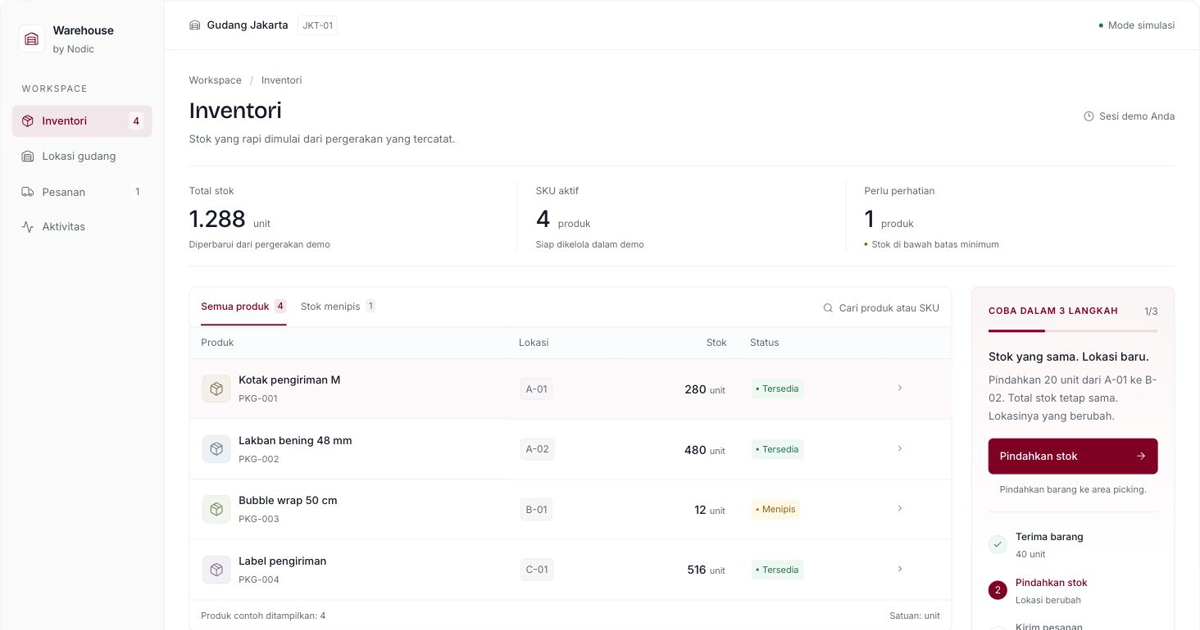
Dummy example: a distributor pilots one warehouse and one product group from receipt through shipment. Acceptance requires traceable balances and transfers that preserve total stock. The pilot does not have to include every integration.
Agree on returns and cancellation handling. Assign adjustment approval rights. Check connectivity and barcode devices when operators actually need them.
Compare feasible options
A spreadsheet can be sufficient for a single owner with simple transactions. Evaluate packaged systems when standard workflows fit. Consider custom development when essential requirements cannot be met through configuration or existing integrations.
Compare data export and implementation support alongside recurring costs. Read the WMS cost-planning guide and request comparable scopes from vendors.
Make the decision with the team
- Select the main operational problem.
- Record a baseline using consistent metric definitions.
- Separate launch requirements from later improvements.
- Assign data and acceptance owners.
- Review the pilot before expanding.
Try the three-step demo and prepare a warehouse brief for a requirements discussion.